FORWARD ON EMAIL
Walking the Tightrope
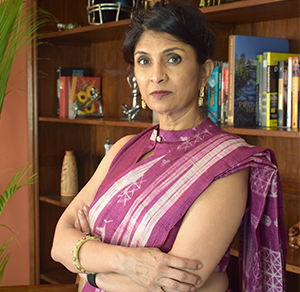
Vani Kola
Managing Director, Kalaari Capital
INTERVIEW • 5 min read



Vani Kola, one of the most well-known names in the industry, shares an inside view on her journey. Vani is known to have the Midas touch- and this tête-à-tête is a glimpse into the sheer grit, hard work, dedication and conviction that goes into turning everything to gold.
Q1. You have been on both sides of the table – as an entrepreneur and as an investor. What did/ do you enjoy more?
A: All of us in our lives will have many journeys, and we are all inherently capable of being good at many things. We may or may not be able to explore all of these. I am an engineer by training, which, combined with the fact that I moved to Silicon Valley, made entrepreneurship viable and accessible for me.
I come from a school of thought that it’s important to be hands-on and detail-oriented. A CEO, to me, always meant Chief Everything Officer, and it means that you take responsibility for all outcomes. I also think entrepreneurs need to have a unique balance between vision and execution and a core understanding of their business. Without that, it’s hard to succeed. To be an entrepreneur requires a single-minded focus to solve a problem, and you have to be willing to give it 4 - 10 years of your life in a very dedicated manner.
Investing is slightly different because it requires you to constantly switch context between business models and founders’ leadership styles. It requires you to strategically think about sectors and broad themes yet be able to get into details of what is working and what isn’t in each company.
At the core, I think of myself as an entrepreneur. Even though I am an investor now, I enjoy it because I bring an entrepreneurship mindset to work every day. I am an investor who believes the product comes first. So, I can’t choose what is closer to my heart – it’s just a phase of life, and at each phase, you do different things, but the curiosity to learn new things and solve problems is what motivates me every day!
Q2. How do you think your tech background helped you become a successful investor today?
A: I still think of myself as a geek in terms of tracking what is happening in the world. I am now investing, and although it is financial services, we really are investing in technology companies. My ability to understand where technology is shifting and what it means for new opportunities is what matters.
A few days back, I spent hours reading about Momentus and SpaceX, and I wondered what it means for the privatization of space and what the potential opportunities are. It doesn’t mean that I will be investing in a space tech company next week. But in a decade will there be an interesting space tech company that would emerge from India - absolutely.
I like reading about the latest technological developments. I wouldn’t be doing what I do if I didn’t have the core background and required skills. I tell young people to expand their skills and not to be one dimensional. Be it doing different things within a company, no matter your background, or trying to do different things along with your career. Each skill adds to other skills you have, and that makes you unique at what you can do.
Q3. What led to your changing fields from engineering to entrepreneurship to investing?
A: How you build relationships is an essential part of being an entrepreneur, being an investor, and being successful in anything you do. This is something that isn’t talked about often, and I always found value in it.
I was on the regular engineering career track in Silicon Valley, and back in 1994, the internet was mostly consumer-focused. I had been working deeply in enterprise software, and I thought about what kind of role the internet could play in enterprise productivity. I went to the CEO of my company and shared some of my ideas. He said, “You know what? I think you should go and start your company. I would be happy to mentor you and provide initial support, be it angel investment or whatever you need”. That’s how I started my entrepreneurial journey.
Building a company is a 24x7 job, and you’re never off the job. It’s also very lonely, and I did that for ten years and built two successful companies. After that, I just didn’t want to do it anymore. As I looked for my next career choice, I thought about how much I like building and looking at new things, and my understanding of technology. I wondered “where can I apply all these things – my interests, knowledge, and skills?” Again, maybe it’s karma, I was sitting in Starbucks with someone, and we were talking about all the things I could be doing next and this person said “how about you invest in India?” I hadn’t thought about that to be honest! I went back home and thought, “What did he say? Oh, that’s a pretty smart idea even if I didn’t think of it myself”. A decade and a half has passed since then, and I have loved being in India!
Right now, I would encourage everyone to be in India and do innovative things. There are plenty of opportunities here! Do interesting things and make a difference!
Q4: How do you see the investing and entrepreneurial landscape evolve in terms of female representation? How is India different from the USA in this context?
A: I don’t think developing countries like India are more handicapped than developed countries like the US. In fact, India might have a slight advantage - there are probably more women in technology at least at the entry-level in India than in other parts of the world. Social challenges exist, but for STEM subjects, I think India is far ahead in the inclusion and participation of women.
Now when you come to entrepreneurship, it is complex because it is a long-term commitment and requires relentless focus. When you want to be an entrepreneur, the timing likely coincides with having a young family as it did for me. Yes, we can lean in and have it all, but it is not easy to balance your home, children, and the start-up. All are equally demanding, and it requires a unique kind of support system – not just physical support but also emotional and cultural support to be able to do that. It’s not that easy, and for all that we talk about, I don’t have simple answers to how you solve for it.
The second part is about access to funding and the ability to hire strong teams.
But despite all the challenges, more women are doing it and paving the way! In fact, between 2009-2018, the number of companies that got funded with female co-founders has risen almost 10x. The number was small, to begin with, and it’s still small now, but at least, the graph is trending in the right direction.
There is, in general, lower representation of women in technology, entrepreneurship, investing, and upward into the LP group. It is great to have role models like Nupur and Renuka, who have set an example in the LP and PE space, respectively. In the entrepreneur space, there’s Divya, co-founder of Byju’s. There are many others, and we need to celebrate that. I think what you’re doing with the Winpe platform – bringing more of these stories out, you never know who you are going to trigger and inspire to take that leap, much like my own journey as an entrepreneur.
So, what I have seen over the last decade is more inclusion and participation, and we need to work to accelerate that collectively!
Q5. What are some of the challenges you faced in your journey so far?
A: I remember this once; I was just getting dressed to leave for a critical board meeting when my daughter threw up all over me. This was when I was an entrepreneur, and this was my own company’s board meeting. What do you do? Do you leave this child behind, or do you cancel the board meeting? There are numerous such occasions.
One of the challenges you will invariably face is this tightrope walk - you are at the epicenter, and you have to build the strength to make tradeoffs and be at peace with them. I had to create support structures and buffers when I needed that backup at work because I had to give that time to family or backup at home because I had to give that time to work. That took some learning on my part, and I started including my kids into my workplace if needed.
The other thing is that because you have two jobs, you are probably not socializing enough either at work or home, and you are not building those networks. Women generally have fewer networks, which means lesser access to mentors, and lesser ability to have friendly outreach. If you are fundraising, you use your network; if you are hiring, you use your network, you have a childcare problem to solve, you use your network. Networks are important. That tightrope walk of work and family is hard, and taking time to build networks, which women generally don’t, is also important. Obviously, all the rest – you have to work hard, be smart, all those things have to be there!
I remember another incident - I had just sold my first company for $1.2 Bn, and it was breaking news. I was in New York and had just signed the deal at the Waldorf. That’s when a reporter called me and asked, “Where are you, and what are you thinking?” I replied, “I’m just in front of the Waldorf, trying to get to the airport.” He persisted, “What is on your mind right now?” and I said, “I’m thinking about my daughter’s 2nd birthday tomorrow and how I’m going to pull it off in such a short amount of time.” He wrote an endearing article about it but, what followed were nasty comments like, “How can you prioritize a business deal over your 2-year old’s birthday?”, “a generation that’s selfish and puts careers ahead of their families” and so on. You read such comments and wonder, “Are they talking about me? But, that’s not me!”
It’s essential not to allow these things to get to you. It is important that you do what you do without guilt, without second-guessing yourself and having clarity on what you want to be, without worrying as much about others’ judgement. If you do, you will live your life for others and not for yourself. You may look back and think, where did I use my potential? I don’t want that for myself or my daughters or any young woman! I want us all to be fulfilled – be it any profession – artist, venture capitalist, engineer! If you are visible and have any modicum of success, there will be more than undue share of judgement or criticism towards a woman than there will be towards a man!
Q6. You are an avid hiker, runner and climbed Mt Kilimanjaro. What inspires you to pursue such adventurous stints?
A: I used to run frequently, but I don’t anymore. I am more focused on meditation and yoga now.
I like to set goals that I could potentially achieve if I’m focused and disciplined. I like to do that because we have to break our mental walls and push ourselves. I don’t think any of us can just keep doing the same thing; it makes us obsolete. Everything we learn is like a step of a ladder, and it contributes towards us doing things in the future.
When I decided to run my first marathon many decades ago, I hadn’t run more than a kilometre before that. So, I set a goal for a year and improved little by little. Part of this is to prove to yourself that you are capable of that discipline, and you get that high of achievement, which is a culmination of all that went in.
When you achieve something, it gives you a tremendous boost to accomplish other things.
Q7. What is your life motto/favorite quote?
A: “Do or do not, there is no try!” - Yoda
Q8. What are some of your favorite books and authors?
A: Currently, ‘Just Mercy’ by Bryan Stevenson. I like to read biographies or memoirs, which make me think and continue to develop as a human being.